With package theft on the rise and smart home security becoming more accessible, choosing the right camera system matters more than ever. Lorex has carved out a reputation for delivering professional-grade surveillance without the recurring cloud subscription fees that plague competitors. Their 4K camera systems offer resolution sharp enough to catch license plate numbers and facial details, crucial for both deterrence and evidence. Whether someone’s protecting a porch, driveway, or entire property perimeter, understanding what sets Lorex apart helps homeowners make an informed investment in security hardware that’ll last.
Table of Contents
ToggleKey Takeaways
- Lorex 4K security cameras provide 3840×2160 pixel resolution to capture license plate numbers and facial details, offering four times the clarity of 1080p systems for superior identification and evidence.
- Unlike Ring or Nest, Lorex systems record locally to a network video recorder (NVR) with no mandatory cloud subscriptions, keeping footage under homeowner control and eliminating recurring fees.
- Wired Power over Ethernet (PoE) connections simplify installation and eliminate battery swaps, making Lorex 4K cameras more reliable than battery-powered alternatives that compromise video quality.
- Color Night Optics technology captures full-color video at night using ambient light and LED spotlights, helping identify vehicle colors and clothing details that infrared alone cannot show.
- Plan your setup by counting coverage zones (front door, driveway, backyard), choosing an NVR with extra channels for expansion, and calculating storage needs—a 2TB drive holds approximately two to three weeks of motion-only recording for four cameras.
- Lorex 4K systems range from $400 to over $1,200 depending on camera count and features, making them an affordable professional-grade alternative to subscription-heavy competitors for homeowners seeking long-term security investments.
What Makes Lorex 4K Security Cameras Stand Out?
Lorex targets homeowners who want commercial-grade specs without paying for monthly cloud storage. Most mainstream brands like Ring or Nest lock key features behind subscriptions: Lorex systems record locally to a network video recorder (NVR) or microSD card, keeping footage under the user’s control.
The 4K resolution, 3840 × 2160 pixels, delivers four times the detail of 1080p. That means clearer zoom on faces, readable text at distance, and better digital cropping after the fact. For outdoor cameras covering driveways or yards, this resolution gap becomes obvious when trying to identify a vehicle or person.
Lorex typically uses wired Power over Ethernet (PoE) connections for their premium 4K systems. PoE runs both power and data through a single Cat5e or Cat6 Ethernet cable, simplifying installation and eliminating battery swaps. Battery-powered 4K cameras exist, but they often compress video aggressively to save power, defeating the purpose of high resolution.
Another standout: no mandatory subscriptions. Recording happens on-site, so there’s no recurring fee to access footage. Cloud backup is optional for those who want offsite redundancy, but it’s not forced. This appeals to DIYers comfortable managing their own data and skeptical of ongoing costs.
Key Features of Lorex 4K Camera Systems
Ultra-High Definition Video Quality
True 4K recording means each frame captures 8.3 megapixels, compared to 2MP for standard 1080p. In practical terms, homeowners can digitally zoom into recorded footage, say, to read a license plate three car-lengths away, without pixelation turning details into blocky mush.
Lorex systems generally record at 15 to 30 frames per second (fps) in 4K mode. Higher fps smooths motion but eats storage faster. A 2TB hard drive might hold roughly two weeks of continuous 4K recording from four cameras at 15fps, though motion-only recording stretches that significantly. Budget for larger drives (4TB or 8TB) if covering multiple angles continuously.
Most Lorex 4K cameras use H.265+ video compression, which cuts file sizes by up to 50% versus older H.264 codecs without sacrificing visible quality. This matters when storing weeks of footage or reviewing clips over a network connection. Playback apps handle the decoding automatically, but older routers or underpowered phones may stutter during remote viewing.
Night Vision and Color Night Optics
Standard infrared (IR) night vision illuminates scenes up to 130–150 feet in total darkness, rendering black-and-white video. IR LEDs ring the camera lens, invisible to the human eye but bright to the sensor. Effective range depends on the camera model and whether obstacles (trees, fences) block the IR throw.
Lorex’s Color Night Optics (CNO) technology uses ambient light, streetlights, porch lights, moonlight, plus a built-in warm LED spotlight to capture full-color video at night. This helps identify vehicle colors, clothing, and other details IR can’t show. The spotlight activates on motion, which can startle intruders but also bugs, pets, or passing cars. CNO cameras typically need at least 1–2 lux of ambient light to produce usable color: pitch-black rural settings still fall back to IR mode.
Compared to competitors, Lorex leans on physical lighting rather than pure digital low-light processing. Systems relying solely on sensor sensitivity improvements sometimes introduce noise or wash out highlights. Lorex balances both, giving users a physical deterrent (visible light) and clearer recorded evidence.
Installation Options: DIY vs. Professional Setup
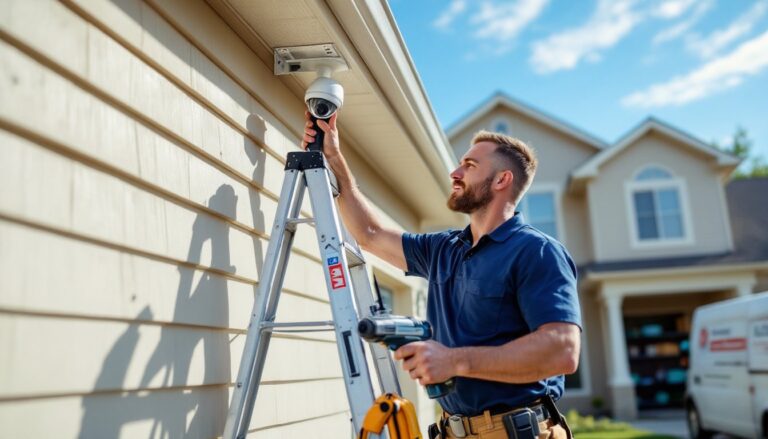
DIY installation is straightforward for those comfortable drilling holes and running cable. PoE cameras require:
• Cat5e or Cat6 Ethernet cable from each camera to the NVR (max run 328 feet per cable)
• A PoE NVR with enough channels (ports) for all cameras plus future expansion
• Drill, 1/2-inch masonry bit for brick/stucco, spade bit for wood siding
• Weatherproof cable connectors or conduit for outdoor runs
• Ladder, voltage tester, cable staples, and silicone caulk
Plan cable routes before mounting cameras. Attic runs work for eaves-mounted cameras: crawlspace or exterior conduit suits ground-level placements. Avoid running cable parallel to electrical wiring for long distances to prevent interference, and never share conduit with AC power lines, NEC Article 800 prohibits mixing low-voltage communication cable with line voltage.
For multi-story homes or complex layouts, routing cable through finished walls gets tedious. Hiring a low-voltage electrician or AV installer runs $100–$200 per camera for labor, including fishing cable and mounting. This makes sense if the homeowner lacks attic access, has stucco that requires special bits, or simply values time over cost.
Permit requirements vary. Most jurisdictions treat low-voltage security cameras as accessory use, not requiring permits. If running conduit on exterior walls or adding a dedicated circuit for the NVR, check local codes. Structural penetrations in fire-rated assemblies or multi-family buildings may need inspection.
For renters or those avoiding permanent installation, Lorex offers wire-free 4K cameras with rechargeable batteries and magnetic mounts. Video quality remains high, but compression increases to conserve power, and Wi-Fi congestion can cause dropouts. These suit temporary setups but lack the reliability of PoE for long-term monitoring. Homeowners weighing camera installation approaches should consider how often they want to recharge batteries versus the effort of running cable once.
Choosing the Right Lorex 4K System for Your Home
Start by counting coverage zones: front door, driveway, backyard, side gates, garage. Each zone typically needs one camera, though wide-angle models (110–130° field of view) can cover adjacent areas. Narrow FOV (60–80°) cameras suit long driveways or hallways, trading width for distance.
NVR channel count dictates expansion. A 4-channel NVR supports up to four cameras: an 8-channel handles eight. Buy more channels than currently needed, adding cameras later costs less than replacing the entire NVR. Most Lorex systems come as kits (NVR plus 4, 6, or 8 cameras), but individual cameras and standalone NVRs are sold separately for custom builds.
Hard drive capacity affects retention time. Lorex NVRs ship with 1TB, 2TB, or no drive (user-installed). Calculate storage needs:
• Continuous recording at 4K/15fps: ~500GB per camera per week
• Motion-only recording: roughly 25–40% of continuous, depending on activity
For four cameras recording motion-only, a 2TB drive holds about two to three weeks. Upgrading to 4TB or 6TB (user must install compatible surveillance-grade drives like WD Purple or Seagate SkyHawk) extends retention or supports more cameras.
Smart detection features, person detection, vehicle detection, motion zones, reduce false alerts from swaying trees or passing shadows. Lorex’s AI analytics run on the NVR, not the cloud, so there’s no latency or subscription requirement. Set motion zones to ignore sidewalks or streets, focusing alerts on driveways and entry points.
Budget considerations: Lorex 4K systems range from $400 for a 4-camera kit with 1TB NVR to over $1,200 for 8 cameras, CNO, and 2TB storage. Prices fluctuate with sales, and security camera discounts often drop during Black Friday or new model releases. Factor in potential cable, conduit, or installation labor if not doing it yourself.
Weather ratings matter for outdoor cameras. Look for IP66 or IP67 ratings, meaning dust-tight and protected against powerful water jets or temporary immersion. Lorex outdoor cameras handle -40°F to 140°F, covering most climates, but extreme heat (desert sun on dark housing) or coastal salt spray may shorten lifespan without periodic cleaning.
Network setup: PoE cameras connect to the NVR’s built-in switch, then the NVR links to the home router via Ethernet. For remote viewing on phones or tablets, the NVR needs internet access. Enable UPnP on the router for automatic port forwarding, or manually forward the NVR’s ports (check the manual for specific ports). Use a static IP for the NVR to prevent connection drops after router reboots.
According to home security experts, integrating 4K cameras with existing smart home platforms varies by brand. Lorex systems support ONVIF protocol, allowing third-party NVR or VMS software, but direct voice control through Alexa or Google Assistant is limited. The Lorex mobile app handles live view, playback, and alerts across iOS and Android.
For households prioritizing ease of use over raw specs, Lorex’s Fusion series combines wired and wireless cameras on one NVR, offering flexibility. For those wanting every camera hardwired for maximum reliability, the 4K Ultra HD IP systems deliver professional performance. Reviews from independent testing labs consistently highlight Lorex’s image clarity and lack of subscription fees as top selling points.
Conclusion
Lorex 4K security cameras deliver high-resolution, subscription-free surveillance suited for DIY-savvy homeowners. Wired PoE systems offer reliability and image quality that wireless competitors struggle to match, while night vision and smart detection features provide practical, everyday utility. Proper planning, cable routes, storage capacity, camera placement, turns a box of hardware into a cohesive security layer that works quietly for years.